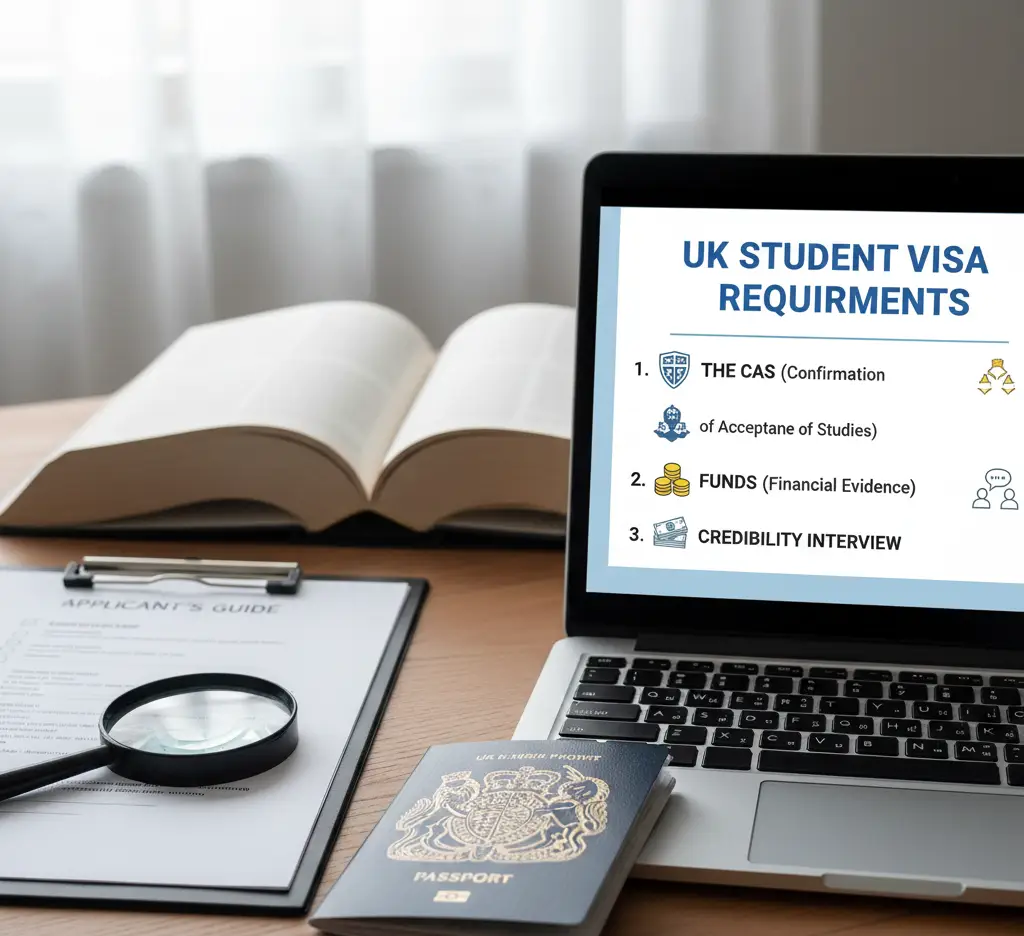
Planning to study in the UK often starts with one big question: what does the UK student visa really require? You need a valid CAS from a licensed university, enough approved funds to support your stay, and a clear, honest explanation of your study plans during the credibility interview. These three areas decide most visa outcomes for international students.
The CAS links your offer to your visa and confirms that a UK institution accepts you. Your finances must meet strict rules, and you must prove the money with the right evidence. The credibility interview checks that you are a genuine student who understands the course and why you chose the UK.
When you understand how these parts connect, the student visa process feels more manageable. This guide explains what UK Visas and Immigration looks for and how you can prepare with confidence.
Understanding the Confirmation of Acceptance for Studies (CAS)
The CAS confirms that a licensed course provider agrees to sponsor your study in the UK. It links your course details, fees, and visa sponsorship to UK Visas and Immigration (UKVI) under the Student route.
What Is a CAS and Why It Is Essential
A Confirmation of Acceptance for Studies (CAS) is an electronic record created by your course provider. It produces a CAS number that you must enter in your UK student visa application.
UKVI uses the CAS to check that a licensed sponsor supports your study. The Home Office reviews the details to confirm your course, dates, fees, and study level. Without a valid CAS, you cannot apply for a Student route visa.
A CAS is not a visa and it is not a paper letter. Some schools call it a CAS letter, but the key item is the reference number. The CAS links your visa application to your sponsor licence and confirms visa sponsorship.
How to Obtain a CAS Statement
You receive a CAS from your course provider after you accept an unconditional offer. The provider must hold a valid sponsor licence.
Most schools issue the CAS after you meet all conditions. These often include academic checks, English proof, and a tuition deposit. Some providers also verify your passport details.
You do not apply to UKVI for a CAS. Your provider submits the information directly to UKVI and then shares your CAS number with you.
CAS issuance timelines vary. Many schools issue it a few weeks before the course starts. Delays happen if documents are missing or details do not match your passport. Always check your CAS details before you apply for the visa.
Requirements for CAS Issuance
Your course provider must confirm that you meet key course requirements and sponsorship rules. Common requirements include:
| Requirement | What You Must Show |
|---|---|
| Course offer | An unconditional offer for an approved course |
| Identity | A valid passport with correct details |
| English level | Evidence that meets course rules |
| Fees | Deposit or full fee payment, if required |
| Study plan | A course that fits the Student route |
The CAS will list your course title, start and end dates, fees, and study location. It may note any fees already paid. UKVI uses this data to assess your visa application. Errors can cause refusal, so ask your provider to correct mistakes before you apply.
Meeting the Financial Requirements and Providing Evidence
You must show clear proof that you can pay your tuition fees and cover living costs in the UK. UK Visas and Immigration checks the amount, the source of funds, and how long you have held the money. Your evidence must meet strict format and timing rules.
Required Funds for Tuition Fees and Maintenance
You need funds to cover any unpaid tuition fees for your first academic year, plus maintenance funds for living costs. The exact amount depends on where you will study.
Maintenance requirements (up to 9 months):
| Study location | Monthly amount |
|---|---|
| London | £1,334 |
| Outside London | £1,023 |
You must multiply the monthly amount by the number of months stated on your CAS. Most courses require nine months.
If your CAS confirms that you have already paid some tuition fees or accommodation, you can deduct those amounts. The CAS must clearly show the payments.
If you bring dependants, higher funds apply. You must meet the full financial requirement before you apply.
Types of Acceptable Financial Evidence
You can use several types of financial evidence, as long as it meets UKVI rules. The most common option is a bank statement in your name or your parent’s name.
Accepted evidence includes:
- Personal bank statements or bank statements from a parent
- An official student loan letter
- An official financial sponsorship letter
- Certificates of deposit, if they meet UKVI rules
All documents must be clear and readable. If a document is not in English, you must include a certified translation.
When using a parent’s funds, you must also provide:
- Your birth certificate
- A signed parental consent letter
Complying with Bank Statement and Sponsorship Rules
Bank statements must show that you held the required funds for at least 28 consecutive days. The closing balance date must be no more than 31 days before your visa application.
Statements must include:
- Your name or your parent’s name
- The bank’s name and logo
- Account number
- Transaction dates and balances
If you use financial sponsorship, the sponsor must be an approved body. This includes the UK government, your home government, the British Council, or a recognised university.
The financial sponsorship letter must confirm:
- Your name and course
- The amount covered, or confirmation of full tuition fees and living costs
- The sponsor’s official contact details
Incomplete or incorrect evidence often leads to refusal, so accuracy matters.
The Credibility Interview and the Genuine Student Requirement
UKVI uses the credibility interview to check that you meet the genuine student requirement under the immigration rules. The process tests your study plans, background, finances, and English communication skills as part of the UK student visa application.
Purpose and Format of the Credibility Interview
The credibility interview helps the Home Office decide if you plan to study and complete your course in the UK. An Entry Clearance Officer (ECO) runs the interview as part of the genuine student assessment.
UKVI usually conducts the interview online or by phone. The interview takes place in English and forms part of the credibility assessment. Your answers must match your application and CAS details.
You may answer questions on:
- Your chosen course and provider
- Why you chose the UK
- How you will fund your studies
- Your plans after graduation
Missing the interview or giving unclear answers can lead to refusal. UKVI treats attendance and accuracy as essential.
Preparing for the Credibility Assessment
Preparation focuses on clarity, honesty, and consistency. You should know your course content, start date, and how it fits your academic background.
Review your CAS and UK student visa application before the interview. Make sure your answers match the information you submitted to UKVI.
Practise clear English communication skills. You do not need complex language, but you must explain your ideas without confusion.
Prepare evidence details, such as:
- Tuition fees and living funds
- Sponsor or personal savings
- Past studies and qualifications
Answer directly and avoid memorised responses. ECOs look for natural, confident explanations that reflect real study plans.
Key Factors Considered by the Entry Clearance Officer
The ECO assesses several factors under the genuine student requirement. Each factor helps UKVI judge your intent to study.
| Factor | What the ECO Checks |
|---|---|
| Academic background | Fit between past studies and your new course |
| Course knowledge | Understanding of modules, length, and outcomes |
| Immigration history | Past visas, refusals, and compliance |
| Finances | Realistic and lawful funding sources |
| Future plans | Clear goals after completing your course |
UKVI also considers your behaviour during the interview. Calm, direct answers support a positive credibility interview outcome.
Completing the UK Student Visa Application Process
You complete the student visa application online and follow a fixed process set by UK immigration rules. You submit documents, give biometrics, and then wait for a decision that allows entry clearance and study in the UK.
Application Procedure and Required Documentation
You start the visa application on the UKVI website using your passport and CAS number. The form asks for personal details, travel history, course information, and sponsor data.
You upload or prepare documents to prove you meet the rules. These often include:
- CAS statement from your education provider
- Proof of funds held for the required period
- Academic documents and transcripts
- Evidence meeting the English language requirement
You also pay the visa fee and the Immigration Health Surcharge (IHS). Some applicants can use priority processing for a faster decision. Always check deadlines linked to your course start date.
Biometric Enrolment and the eVisa
After submitting the application, you book an appointment at a visa application centre. You provide a photograph and fingerprints to confirm your identity.
Some applicants use the UK Immigration: ID Check app instead. This creates a UKVI account and links your status to a digital eVisa.
If approved, you no longer receive a biometric residence permit in most cases. Your eVisa shows visa validity, work limits, and study conditions. You can prove your status using a share code when needed.
After the Decision: Approval, Refusal, and Next Steps
If you receive visa approval, you may also get a short visa vignette in your passport. This allows entry clearance to travel to the UK. You must enter within the dates shown.
After arrival, you complete student enrolment with your sponsor. Your eVisa remains your main proof of status.
If you receive a visa refusal, the notice explains the reason. Common issues include funds, credibility, or general grounds for refusal. Some refusals allow an administrative review. In limited cases, you can submit a new or in-country application with corrected information.
Ready to take the next step with your UK immigration plans? Garth Coates Solicitors can guide you from strategy to submission with clear, practical advice. Whether you’re launching a business through the uk start up visa, reuniting with a partner using trusted spouse visa solicitors, or exploring the uk self sponsorship visa, we’re here to help. If you’ve faced a setback, we can also support your visa refusal uk appeal with a robust case and next-step plan.