British citizenship gives you the right to live in the UK free of immigration control, to hold a British passport and to vote in all UK elections. Most adults become British by naturalisation after they have settled here. Many children become British by registration, which has different rules.
British citizenship at a glance
- Who it is for
- You must be 18 or over, have lived in the UK 5 years (3 if married to a British citizen) and usually held indefinite leave for 12 months.
- Where you can apply from
- You can apply online or by post. If you live in the Channel Islands, Isle of Man or a British overseas territory, apply by post or in person.
- English language
- You must prove your knowledge of English, Welsh or Scottish Gaelic, and you must pass the life in the UK test.
- Family members
- You must apply separately for each child. Children born outside the UK, or in the UK before you got indefinite leave, can be registered; others may already be British.
- Decision time
- You will usually get a decision within 6 months. Some applications take longer, and you will be told before the 6 months have passed.
From the official GOV.UK guidance, checked 2 November 2026.
Overview
Once you are a British citizen, you no longer need a visa or eVisa to live or work here, and you cannot lose your status by spending time abroad. Citizenship can only be taken away in narrow cases, such as where it was obtained by fraud.
Two recent changes matter:
- For applications made since 10 February 2025, anyone who arrived in the UK without a visa or electronic travel authorisation after a dangerous crossing, for example by small boat or hidden in a vehicle, will normally be refused citizenship, however long ago that was.
- In 2026 the Home Office introduced a priority service for online citizenship applications, with a decision usually within 30 working days.
The English level for citizenship remains B1. The move to B2 from 26 March 2027 applies to settlement applications, so people who settle after that date will already meet it.
Who can apply
The main routes are:
- Adults with indefinite leave to remain or settled status, who have held it for 12 months and lived in the UK for at least 5 years (naturalisation).
- Adults married to, or in a civil partnership with, a British citizen, who have indefinite leave or settled status and have lived here for at least 3 years. There is no 12-month wait after settlement.
- Children under 18 born in the UK, where a parent became British or settled after the birth (registration as of right).
- People of any age born in the UK who lived here until they were 10 (registration as of right).
- Other children under 18, for example a child born abroad who now lives here with settled parents, at the Home Office's discretion.
You do not need to apply if you are already British. A child born in the UK when a parent was British or settled is usually British automatically and just needs a passport. Someone born abroad to a British parent may also be British already.
EU citizens usually apply once they have settled status. Some with pre-settled status can apply earlier, if they have lived here for 5 years in a row while working, studying or self-sufficient, and then for a further year (unless married to a British citizen). See our page on settled and pre-settled status.
Requirements
To naturalise as an adult you must:
- be 18 or over;
- have been physically in the UK on the date exactly 5 years (or 3 years, if married to a British citizen) before the Home Office receives your application;
- have spent no more than 450 days outside the UK in those 5 years (270 days on the 3-year route), and no more than 90 days in the last 12 months;
- have been free of immigration time limits for the last 12 months (on the 3-year route, on the date you apply);
- not have broken immigration law during the residence period;
- be of good character;
- show English at B1 in speaking and listening, unless exempt;
- have passed the Life in the UK test;
- on the 5-year route, intend to keep living in the UK.
You also need two referees who have known you for at least 3 years. One must be a professional person of any nationality. The other must be a British passport holder who is either a professional person or over 25. Neither can be related to you or to each other, or be your solicitor.
Absences
The Home Office has discretion over absences. It normally overlooks up to 480 days in 5 years (300 on the 3-year route) and up to 100 days in the last year, and may accept more where there were strong reasons, such as a job posting abroad for a UK employer.
Good character
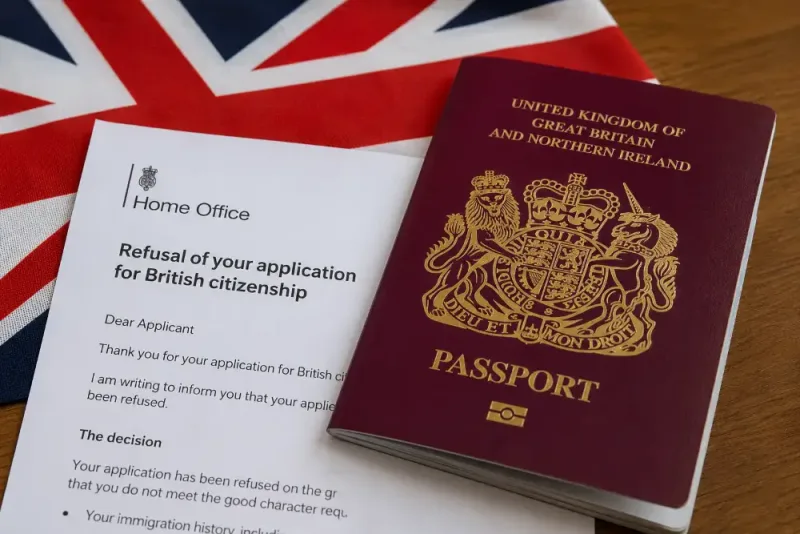
This is where most refusals come from. The Home Office looks at criminal records, immigration breaches in the last 10 years, deception, and financial conduct such as deliberate debt or unpaid NHS charges. A prison sentence of 12 months or more will normally lead to refusal. Shorter sentences, fines and cautions do not lead to automatic refusal, but the Home Office must be satisfied that you are of good character despite them.
For people who arrived illegally, the 2025 policy above applies. Illegal entry is normally disregarded where it was outside the person's control, for example a young child brought by adults, or a victim of trafficking. A refugee who has a legal defence for illegal entry under the Refugee Convention must not be refused on that ground alone.
Answer every question on the form fully, even about old or minor matters. Leaving something out can lead to refusal for dishonesty, even where the matter itself would not have.
Registering children
Children under 18 do not need to pass the Life in the UK test or show English. Children aged 10 or over must be of good character. A child registering after living here until 10 must not have spent more than 90 days outside the UK in each of those first 10 years, although longer absences can be explained. Where a family cannot afford the fee for a child, a fee waiver can be requested.
How to apply
- Work out your earliest date: check where you were on the date 5 (or 3) years back, and count your absences.
- Gather your passports, proof of your settled status (your eVisa details), your English and Life in the UK evidence, and your referees' details.
- Apply online: form AN for adults, form MN1 or form T for children. Pay the fee and choose priority if you want it.
- Attend a UKVCAS appointment to give your fingerprints and photo. Upload your documents or have them scanned.
- Answer any Home Office questions. You may be invited to an interview, held in English.
- If approved, book and attend a citizenship ceremony within 3 months of your invitation. You make an oath or affirmation and a pledge, and receive your certificate.
- Apply for your British passport.
Costs
An adult pays the Home Office application fee and a citizenship ceremony fee. A child's registration has its own fee, with a ceremony fee only if the child turns 18 during the process. The current figures are on this page and in our visa cost calculator.
Other costs include the priority service if you use it, an English test if you need one, and your first British passport.
Processing times
Standard applications are usually decided within 6 months. With the priority service, an application is usually decided within 30 working days, unless further checks are needed.
Partners and children
Each adult applies separately, although partners who settled together can apply at the same time, usually 12 months after settling.
Each child needs their own registration application. For a child born abroad who lives here with you, registration is at the Home Office's discretion, which looks at the child's ties to the UK and both parents' status. It helps if both parents are settled or British.
For partners who are not yet settled, see our Spouse visa and indefinite leave to remain pages.
Extending your stay and settlement
Citizenship is the end of the immigration process, so there is nothing to extend. After your ceremony, apply for a British passport. You cannot use your certificate to re-enter the UK, so plan any trips abroad around your passport application.
Your children born outside the UK after you become British are normally British automatically, because citizenship passes down one generation. Their own children born abroad will not be automatically British, so families who live overseas should plan for that.
How we can help
We check your eligibility before you pay a fee, including your exact residence dates, your absences and anything that may raise a good character question. If there is a problem, such as a past overstay, a conviction or a long absence, we tell you whether to apply now or wait, and how to present it.
We prepare the application and any legal representations, check your referees and documents, and deal with Home Office requests. For children, we advise on the right route and prepare registration applications, including discretionary ones. If you are refused, we advise on reconsideration. To discuss your case, book a consultation.
Frequently asked questions
I am married to a British citizen. Do I have to wait 12 months after settling?
No. You can apply as soon as you have indefinite leave or settled status, provided you have lived here for 3 years and meet the other requirements.
I have spent 520 days abroad in the last 5 years. Can I still apply?
Possibly. That is above the 480 days normally overlooked, so you need strong reasons, such as work abroad for a UK employer, and clear ties to the UK. Waiting a few months until older trips fall outside the 5 years is often simpler.
Will a minor offence stop me becoming British?
Not automatically. The Home Office looks at what happened, how long ago and how you have behaved since. A single minor matter years ago is viewed very differently from a pattern of offending.
My child was born in the UK before I settled. Is she British?
Not automatically. Once you settle or become British, you can register her while she is under 18. If she lives here until she is 10, she can also register in her own right.
Can I appeal if I am refused?
There is no right of appeal against a citizenship refusal. You can ask the Home Office to reconsider on form NR if you believe it got the law or policy wrong, or make a new application once the problem has been dealt with.
Can I keep my current nationality?
The UK does not ask you to give it up. Whether you keep it depends on the law of your other country, so check with its embassy before you apply, and ask whether you must register your new nationality there.
This page is general information about UK immigration rules, not legal advice on your circumstances. Home Office fees shown on this page are taken from GOV.UK; the date they were last checked is shown beside them. For advice on your case, request a consultation.