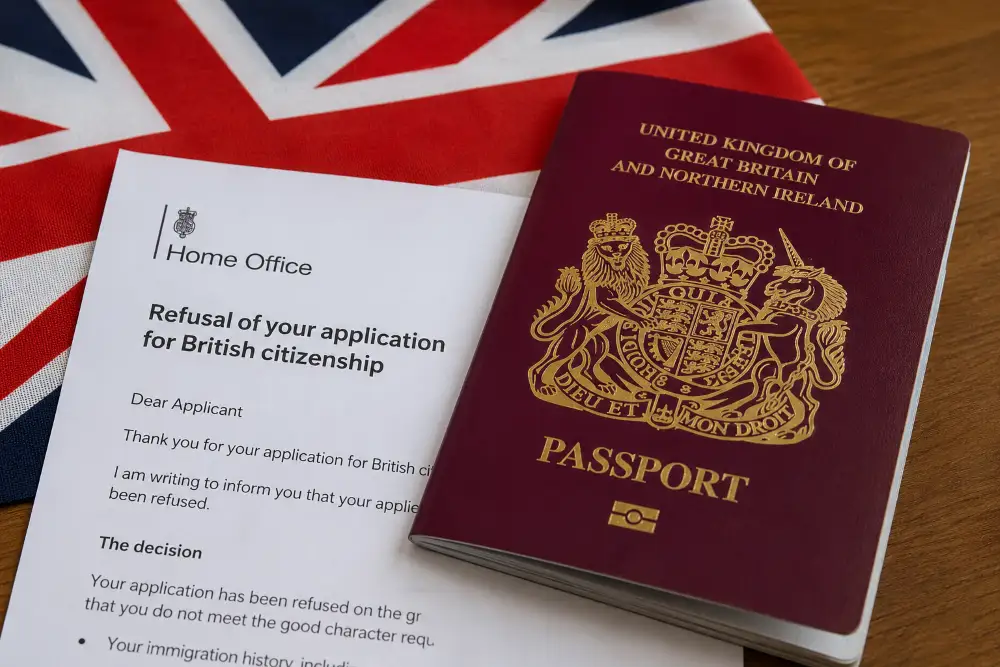
The Home Office has withdrawn several British citizenship refusal decisions following legal challenges concerning its “good character” policy, raising important questions for applicants who may have been refused naturalisation or registration on the basis of past immigration history.
According to a recent report by Free Movement, four lead judicial review claims challenged the Home Office’s February 2025 good character guidance, which stated that applicants who had entered the UK illegally, or arrived without valid entry clearance or electronic travel authorisation after making a dangerous journey, would normally be refused British citizenship. The policy applied regardless of when the person had arrived in the UK.
Following a High Court hearing on 9 June 2026, three of the lead cases resulted in the Home Office withdrawing both the original citizenship refusals and the reconsideration decisions which had maintained those refusals. The Court also ordered the Home Office to pay the claimants’ costs in those cases.
The development is particularly significant because British citizenship applications do not carry a general right of appeal. Where an application is refused, an applicant may need to consider a reconsideration request, a fresh application, or judicial review proceedings, depending on the facts of the case and the reasons for refusal.
The Home Office published revised good character guidance on 30 April 2026. The revised guidance confirms that each application must be considered on its own merits and that decision-makers must assess the applicant’s character on the balance of probabilities. It also includes additional wording on circumstances where illegal entry or arrival may have been outside the applicant’s control, including cases involving children or victims of trafficking.
The guidance further recognises that a refugee with a valid defence under section 31 of the Immigration and Asylum Act 1999 must not be refused citizenship solely because of the illegal entry or overstaying which forms part of that defence. However, other good character issues may still be considered by the Home Office.
“This development shows how important it is for applicants to obtain proper legal advice before accepting a citizenship refusal as final,” says Mr Garth Coates, Principal Partner/Senior Solicitor at Garth Coates Solicitors. “A refusal based on good character grounds can have long-term consequences, but in some cases the decision may be open to legal challenge or reconsideration.”
There has also been a recent change to the Home Office’s nationality reconsideration guidance. The updated guidance now states that the Home Office expects reconsideration requests to be submitted within six months of the date of decision. Although this appears to be expressed as an expectation rather than an absolute deadline, affected applicants should act promptly, particularly where a refusal was issued several months ago.
Applicants who were refused British citizenship under the February 2025 version of the good character guidance should urgently review the refusal letter, the date of decision, the reasons given by the Home Office, and any evidence which may show that the decision was not properly made. This may include evidence of refugee status, trafficking, childhood circumstances, lack of control over the method of arrival, delay caused by the Home Office, or wider evidence of positive character and contribution to society.
Mr Celemet Yener, Partner Solicitor at Garth Coates Solicitors, states: “Good character decisions are highly fact-sensitive. The Home Office must consider the full circumstances of the applicant, not simply apply a blanket approach. Where an applicant believes that relevant evidence was overlooked or the policy was wrongly applied, they should seek advice without delay.”
The latest developments do not mean that all citizenship refusals based on illegal entry or immigration breaches will automatically be withdrawn. However, they do underline the importance of careful legal analysis in cases where the refusal may have been based on an overly rigid application of policy or where important mitigating factors were not properly considered.
Anyone affected by a British citizenship refusal should take specialist advice as early as possible. Time limits can be critical, particularly where judicial review may be required.