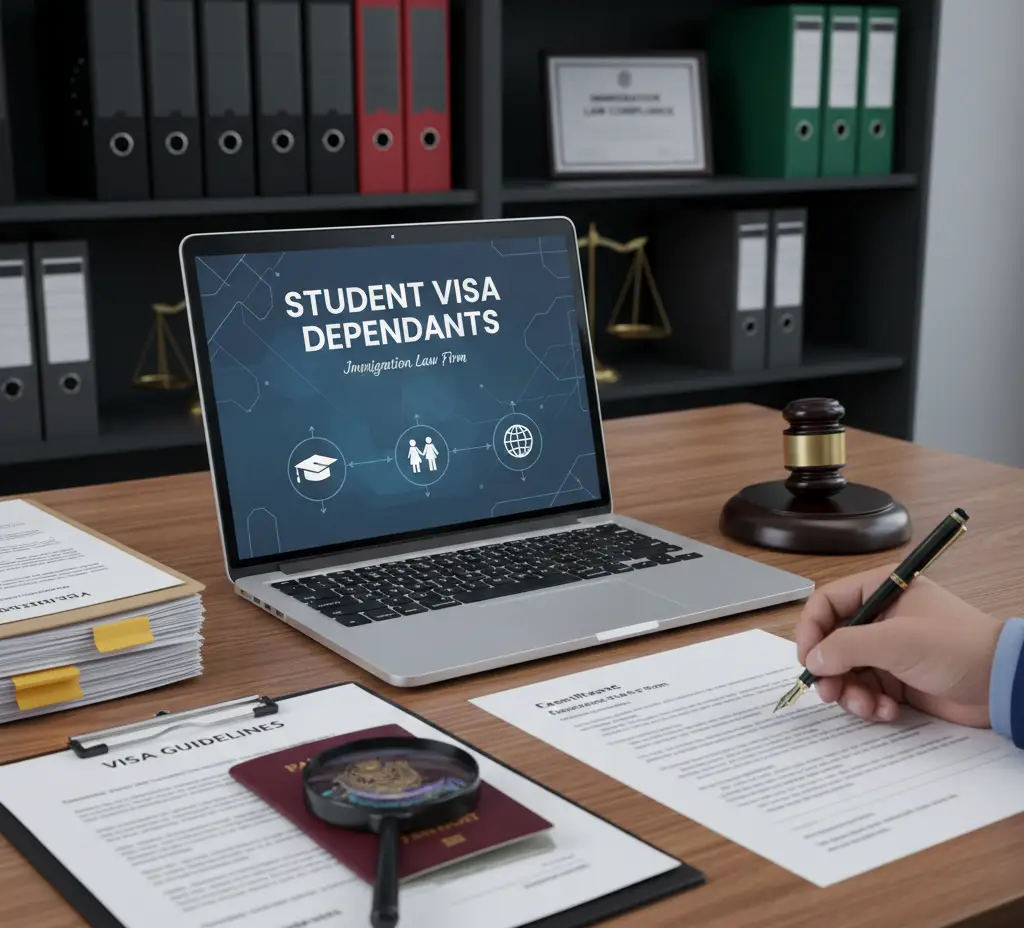
Bringing family members to the UK while studying is one of the most emotionally loaded parts of any Student route plan. It is also one of the areas where otherwise straightforward applications get refused — not because the relationship is not genuine, but because the rules are tighter than many people expect and the evidence is often uploaded without a clear structure.
Garth Coates Solicitors sees the same pattern repeatedly: successful dependant applications are built on 2 foundations — eligibility (does the main Student actually qualify to bring dependants?) and verifiable evidence (does the paperwork prove relationship, funds and living arrangements in the way a caseworker needs to see?). This guide breaks down both.
For the broader Student route context, see their Student visa solicitors page and the firm’s practical explainer, UK Student Visa Requirements: the CAS, funds, and credibility interview explained.
Who can bring dependants on a Student visa?
The starting point is simple: not every student can bring a partner or children.
Under current Home Office rules, a Student’s partner and children (“dependants”) can usually apply only if the Student is either:
- a government-sponsored student starting a course lasting longer than 6 months, or
- a full-time postgraduate (RQF level 7 or above) course lasting 9 months or longer.
However, there is a crucial restriction for newer postgraduate courses. If the postgraduate course starts on or after 1 January 2024, it must be either:
- a PhD / doctorate (RQF level 8), or
- a research-based higher degree.
In practice, this is where many families fall at the first hurdle: a taught Master’s course may meet the level and length requirement, but still not meet the “research-based” requirement if it started after the January 2024 cut-off.
If the study plan is not a match, it may be worth checking alternatives such as the Short-Term Study visa (where appropriate) or understanding linked routes for family members via the firm’s UK family visas resources.
Who counts as a “dependant”?
A Student dependant is typically one of the following:
- husband, wife or civil partner
- unmarried partner
- child under 18, including a child born in the UK during the Student’s stay
Children have additional conditions. The Home Office expects evidence that the child is not married/in a civil partnership and is living with the parent, unless living away for full-time education (for example, boarding school or university).
Financial requirement: how much money must dependants show?
Even when the Student qualifies, many refusals are driven by technical financial errors: wrong amount, wrong account type, or not held for long enough.
The Home Office sets monthly maintenance amounts for dependants, on top of the Student’s own funds requirement. The dependant amounts are:
- £845 per month (up to 9 months) for courses in London, per dependant
- £680 per month (up to 9 months) for courses outside London, per dependant
Key timing rules matter just as much as the number: the money must be held for at least 28 consecutive days, and the end date of that 28-day period must fall within 31 days of the application date.
Some applicants may not need to upload financial evidence (for example, if they have been in the UK with valid permission for at least 12 months, or if “differential evidence” applies) — but the funds requirement still has to be met.
For deeper Student route financial detail (including what counts as acceptable evidence), the government’s financial evidence guidance is worth reading carefully.
What documents do Student dependants usually need?
While each family’s bundle differs, the strongest applications tend to be organised into clear sections.
A) Core identity documents
Typically includes passports and any UK immigration status evidence where relevant (for example, prior BRP history if the person already held permission). The UK is also moving toward online status records, so HR-style checks and share codes increasingly matter. For practical context, see eVisas and digital status: what HR teams need to change.
B) Proof of relationship (partner)
The Home Office expects evidence of the relationship — for example, a marriage/civil partnership certificate, or evidence supporting an unmarried partnership.
Where unmarried partners are involved, it is rarely enough to upload photos and chats. The strongest bundles tend to use a “shared life” structure: address history, joint responsibilities, and selective communication evidence that supports continuity. Garth Coates’ guide, Spouse visa relationship evidence: what works and what gets ignored, is highly relevant even when the dependant route is Student-based, because caseworkers assess credibility in very similar ways.
C) Proof of relationship (children)
The Home Office commonly expects a birth certificate for each child and, where needed, evidence that the child is living with the parents.
For older children (or where the Home Office asks for address confirmation), the guidance lists examples such as bank statements, credit card bills, a driving licence, NHS registration, or an official letter from a university or college showing the child’s address.
D) Financial evidence (when required)
If evidence must be uploaded, it should be clean, legible, consistent, and clearly show that the required balance was held for the full 28 days.
E) A simple cover letter and document index
This is not mandatory, but it often makes the difference. A 1–2 page cover letter that explains:
- course details and why the Student qualifies to bring dependants
- where funds are held and how the figures were calculated
- what evidence proves relationship and living arrangements
Common reasons Student dependant applications are refused
Garth Coates Solicitors commonly sees refusals driven by:
- Ineligibility of the main Student (for example, a taught postgraduate course starting after 1 January 2024)
- Financial evidence errors (wrong amount, not held for 28 days, incorrect date window, or unacceptable evidence format)
- Weak relationship proof (especially for unmarried partners relying heavily on screenshots rather than verifiable documents)
- Children’s evidence gaps (living arrangements unclear, missing address proof where requested)
- Messy uploads (important documents buried in dozens of unrelated files)
If a dependant is refused: what are the options?
Many Student route refusals do not come with a full right of appeal. Often, the route is an administrative review (where the Home Office checks for a caseworking error), or a fresh application — but the refusal letter is the document that decides which options are available.
Administrative review deadlines are tight: typically 14 days if the application (and refusal) happened in the UK, and 28 days if it was refused from outside the UK.
For strategy around refusals and challenges, Garth Coates’ UK visa refusals page is a good starting point, alongside appeals and judicial review where a case demands stronger action.
Student dependant applications are rarely “just paperwork” — they are family plans on a deadline, often tied to course start dates, housing, and schooling. Garth Coates Solicitors can assess eligibility, map out the strongest evidence, and present a clear bundle built for how Home Office caseworkers actually decide these cases.
To speak with the team, use the firm’s contact page and, for transparency on scope and cost, review services and fees.
Ready to move forward with your UK immigration plans? Garth Coates Solicitors can guide you at every step — from eligibility checks and document preparation to submission and follow-up. If you’re launching a business, our uk start up visa team can help you build a strong application. Need support with work routes? Speak to a trusted skilled worker visa solicitor today. We also advise on the uk self sponsorship visa for entrepreneurs seeking more control. Studying in the UK? Our student visa solicitors are here to help — contact us now for tailored advice.