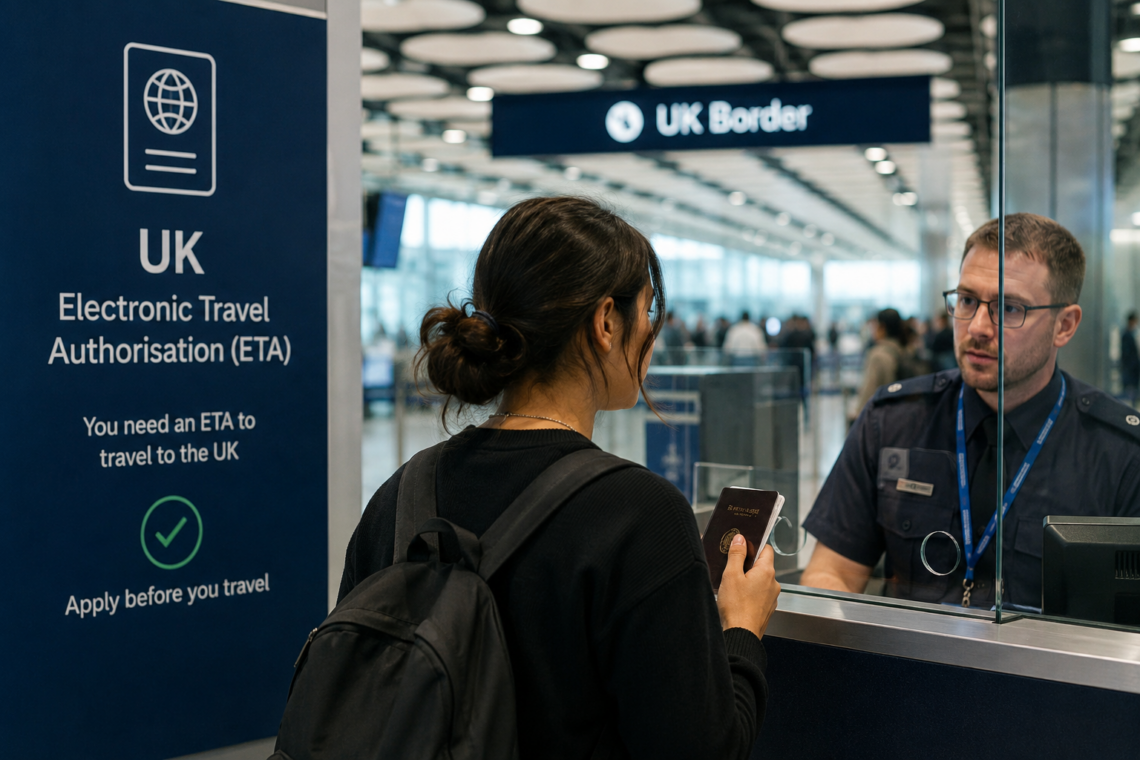
Many visitors who previously travelled to the UK with only a passport now need an Electronic Travel Authorisation, commonly known as an ETA, before travelling.
This is a major change for tourists, business visitors, family visitors, short-term students and some transit passengers. It affects many people who do not normally need a visa to visit the United Kingdom.
The UK Government has confirmed that visitors from 85 nationalities, including the United States, Canada and France, who do not need a visa will not be able to legally travel to the UK without an ETA from 25 February 2026, unless they are exempt.
What is an ETA?
An ETA is digital permission to travel to the UK. It is not a visa, and it is not the same as permission to enter the UK.
GOV.UK states that an ETA allows a person to travel to the UK, Jersey, Guernsey or the Isle of Man for up to six months for tourism, visiting family or certain other permitted reasons. It currently costs £20.
Importantly, GOV.UK also states that an ETA does not guarantee entry to the UK. A person may still be questioned at the border and must satisfy the border officer that they meet the relevant visitor requirements.
Who usually needs an ETA?
Most visitors now need either an ETA or a visa before travelling to the UK.
GOV.UK explains that a person usually needs an ETA rather than a visa if they are from Europe, the USA, Australia, Canada or certain other countries. Whether a person needs an ETA or a visa depends on their nationality, the reason for travel and whether they already hold UK immigration permission.
People who already have permission to live, work or study in the UK do not normally need an ETA. British and Irish citizens are also exempt.
Each traveller must obtain their own ETA, including babies and children.
Why this matters for international families
The ETA requirement can easily be overlooked by families.
A parent may remember to apply for themselves but forget that each child also needs separate permission to travel. A family may book flights first and only later realise that one member has an issue with their ETA application. This can create serious travel disruption.
Families visiting the UK for weddings, graduations, medical visits, holidays or to see relatives should check ETA requirements before booking flights.
Where there is any previous immigration history, criminal record, previous refusal, overstay or removal decision, legal advice should be obtained before travel arrangements are made.
Why this matters for business travellers
The ETA system is also important for business visitors.
Many business travellers from visa-exempt countries previously assumed that they could simply arrive in the UK with a passport and explain their visit at the border. That approach is now risky.
Business visitors may need an ETA before travelling for meetings, conferences, negotiations, site visits or other permitted business activities. However, an ETA does not give permission to work in the UK.
The visitor rules remain strict. A person must ensure that their planned activities are permitted as a visitor. If the real purpose of the visit is employment, paid work, long-term business activity or setting up operations in a way that goes beyond permitted visitor activities, another immigration route may be needed.
Transit passengers should also check the rules
ETA requirements may also affect some transit passengers.
The Home Office factsheet explains that eligible visitors who take connecting flights and go through UK passport control need an ETA. Visitors without an ETA may be unable to board their transport and cannot travel to the UK unless exempt.
This is particularly important for passengers with connecting flights through London or other UK airports. A short stopover may still require advance permission depending on the route and whether the passenger goes through border control.
What if an ETA is refused?
An ETA refusal can be serious.
If an ETA is refused, the person may need to apply for a visitor visa instead. They should not simply try to travel without resolving the issue. Airlines and carriers may refuse boarding, and arrival at the UK border without the correct permission can create further immigration problems.
A refusal may arise for various reasons, including previous immigration issues, criminality concerns, identity problems or information given in the application.
Anyone refused an ETA should take advice before making a further application.
Common mistakes to avoid
Visitors should avoid the following mistakes:
- assuming that visa-free travel means no pre-travel permission is needed;
- applying too late;
- using unofficial websites that charge excessive fees;
- forgetting to apply for children;
- failing to update travel document details;
- assuming that ETA approval guarantees entry;
- using an ETA for work or activities not permitted as a visitor;
- ignoring previous UK immigration problems.
The ETA is part of the UK’s wider move towards a digital immigration system. It may make travel more efficient for many people, but only if applications are made correctly and in good time.
Garth Coates Solicitors comment
The ETA system is a major change for people who previously travelled to the UK without a visa.
For many visitors, the process may be straightforward. However, problems can arise where a person has a complex immigration history, a previous refusal, a criminal record, a past overstay or uncertainty about whether their planned activities are permitted.
The most important point is to check before travelling. A refused or missing ETA can disrupt flights, family visits, business meetings and urgent travel plans.
An ETA is not a substitute for legal advice where the purpose of travel is complex or where the visitor may need a different visa route.
How Garth Coates Solicitors can help
Garth Coates Solicitors advises individuals, families and business visitors on UK visitor rules, ETA issues and visa applications.
We can assist with:
- checking whether an ETA or visitor visa is required;
- advising on permitted visitor activities;
- preparing visitor visa applications;
- advising after ETA refusal;
- assisting with previous refusal or overstay issues;
- advising business visitors and companies;
- reviewing travel plans involving family, medical or business visits.
If you are unsure whether you need an ETA or a UK visitor visa, contact Garth Coates Solicitors before making travel arrangements.
Call us on +44 (0)20 7799 1600 or contact us to request a consultation and we will get back to you within 2 business days.